
Pablo Casals stands as one of the greatest musicians of the 20th century, and at the heart of his artistic identity was a single instrument: a Goffriller cello made in Venice in the early 18th century. Casals was also a close friend of Queen Elisabeth of Belgium; a bond grounded in music, humanism and mutual respect that extended well beyond the concert stage. This year, the Fundació Pau Casals will loan the ‘Casals’ Goffriller to the First Laureate of the Queen Elisabeth Cello Competition for four years.
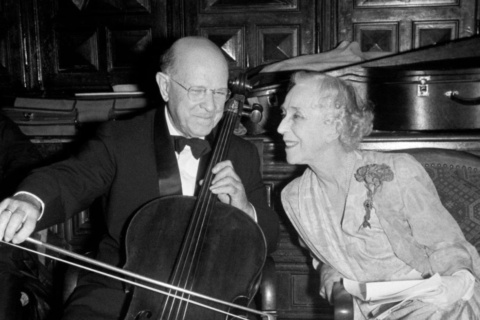
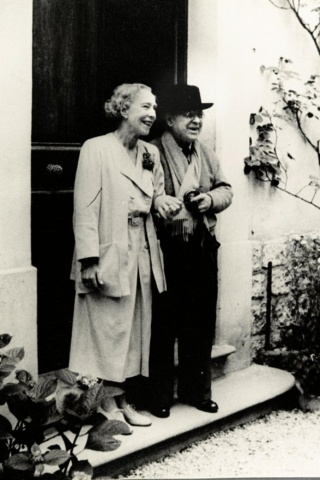
Pablo Casals and Queen Elisabeth (Photo: Fundació Pau Casals).
Introduction
Casals acquired his Goffriller in 1908 and remained devoted to it for sixty-five years, playing it until his death in 1973. Built around 1710, this cello possesses the hallmarks of Goffriller’s mature work: a broad, powerful model; a rich, textured, deep-red varnish; and an extraordinary depth of tone, particularly across the lower register. Unlike the refined elegance associated with Stradivari, Goffriller’s cellos are known for a visceral, almost baritonal sonority—direct, earthy, and intensely human—qualities that proved ideal for Casals’s musical temperament.
Casals’s sound was never merely beautiful; it was rhetorical. He approached phrasing as speech, with inflection and breath. The Goffriller’s robust core and complex overtones amplified this approach. In his landmark recordings of the Bach Suites in the late 1930s, one hears not just technical command but a timbral authority—an instrument that speaks from the chest rather than the throat. The lower strings possess weight without muddiness; the upper register projects without strain. It became, in effect, an extension of his political and moral voice as well.
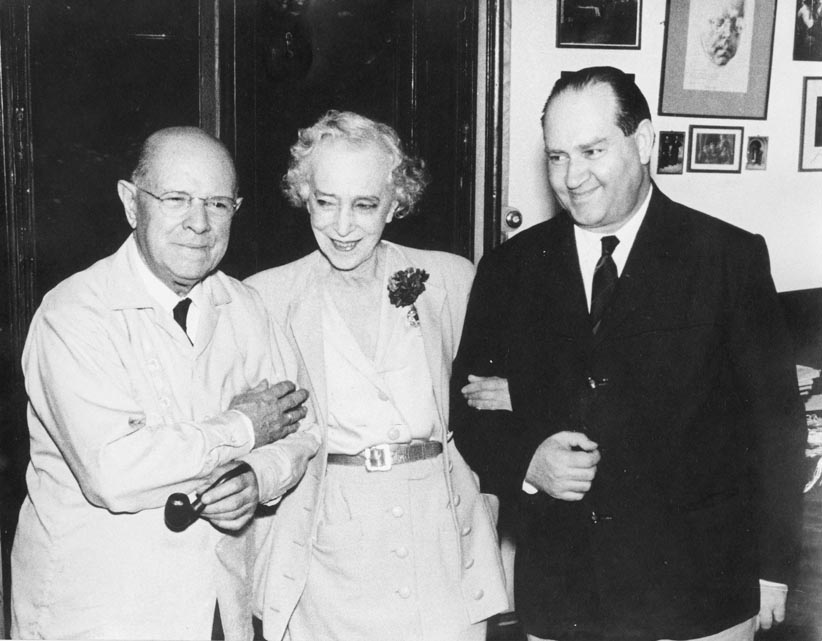
Pablo Casals, Queen Elisabeth, David Oistrakh (Photo: Fundació Pau Casals)
Exiled from Spain following the rise of Franco, Casals settled in Prades, France, where he continued to perform and teach. The Goffriller accompanied him through this period of artistic and personal resistance. When he emerged from relative silence to create the Prades Festival in 1950—marking the bicentenary of Bach’s death—the Goffriller once again carried his Bach interpretations to an international audience. By then, both man and instrument had acquired near-mythic status.
The association between Casals and the Goffriller also shifted market perception. When Casals acquired his Goffriller in 1908, Venetian cellos were considered less valuable and less prestigious compared to those from Cremona. Cellists and connoisseurs began to understand that the Venetian school—particularly Goffriller and Montagnana—could rival and even surpass Cremonese instruments in projection and character. Casals could have chosen a Stradivari––but he didn’t.
Casals did not merely play the Goffriller; he revealed what such an instrument could become in the hands of an artist of conviction. Through that partnership, the cello emerged as a modern solo voice—profound, uncompromising, and unmistakably human.
Casals did not merely play the Goffriller; he revealed what such an instrument could become in the hands of an artist of conviction.
Today, in a gesture that binds past to present, the instrument is entrusted to the winner of the Queen Elisabeth Competition, honoring Casals’s enduring friendship with Queen Elisabeth and reaffirming his lifelong mission: that music—and the voice of his cello—should reach beyond the concert hall to speak directly to people everywhere.

Matteo Goffriller
Matteo Goffriller (c.1659–1742) was the first in a long line of great Venetian cello makers. His ideas and models directly influenced generations of makers, and the instruments he created have been favored by many of the most important cellists of the modern era. Goffriller cellos are renowned for the deep, powerful tonal character that the ‘Casals’ so perfectly embodies.
In 1685, Goffriller came to Venice from the Tyrolean town of Bressanone to join the workshop of Matthias Kaiser. Kaiser was primarily a builder of lutes and other plucked instruments, while Goffriller appears to have focused early on on bowed instruments, particularly cellos. In fact, of the surviving instruments attributed to Goffriller the ratio of cellos to violins is approximately 2:3; with Stradivari, in contrast, the ratio is closer to 1:10.
Goffriller created cellos in a wide range of sizes, from 70 to nearly 80 cm—the modern standard is around 75 cm. His methods of construction resulted in subtle asymmetries and the ability to create larger and smaller instruments by scaling up and down his model according to demand. Although we now refer to all cello-sized instruments made by makers like Goffriller, Stradivari, and Amati as cellos, the large instruments were referred to at the time as violones, bassos di viola or bassettos. Interestingly, the term violoncello (diminutive of violone) only emerged around 1665.
At the turn of the 18th century, the cello had a very different role in music than it does today. Composers largely used the cello as the structural and rhythmic continuo voice of an ensemble, and rarely gave it the melodic line. By the mid 18th century, however, classical composers started to demand new levels from the cello, especially in chamber and solo contexts. In the quartets of Franz Joseph Haydn, the cello became a true conversational partner, not just harmonic support. It started to introduce themes, answer motifs and shape structure, rather than sit underneath it. The incredible virtuosity demanded by the cello concertos of Boccherini, Vivaldi and Haydn, among others, posed a significant challenge. The ornate, virtuosic passages compelled cellists into athletic playing—scrambling up and down the fingerboard and executing precise string crossings—all while projecting over top of the orchestra accompanying it. This level of performance was practically impossible on an instrument with a body length of more than 76 cm.
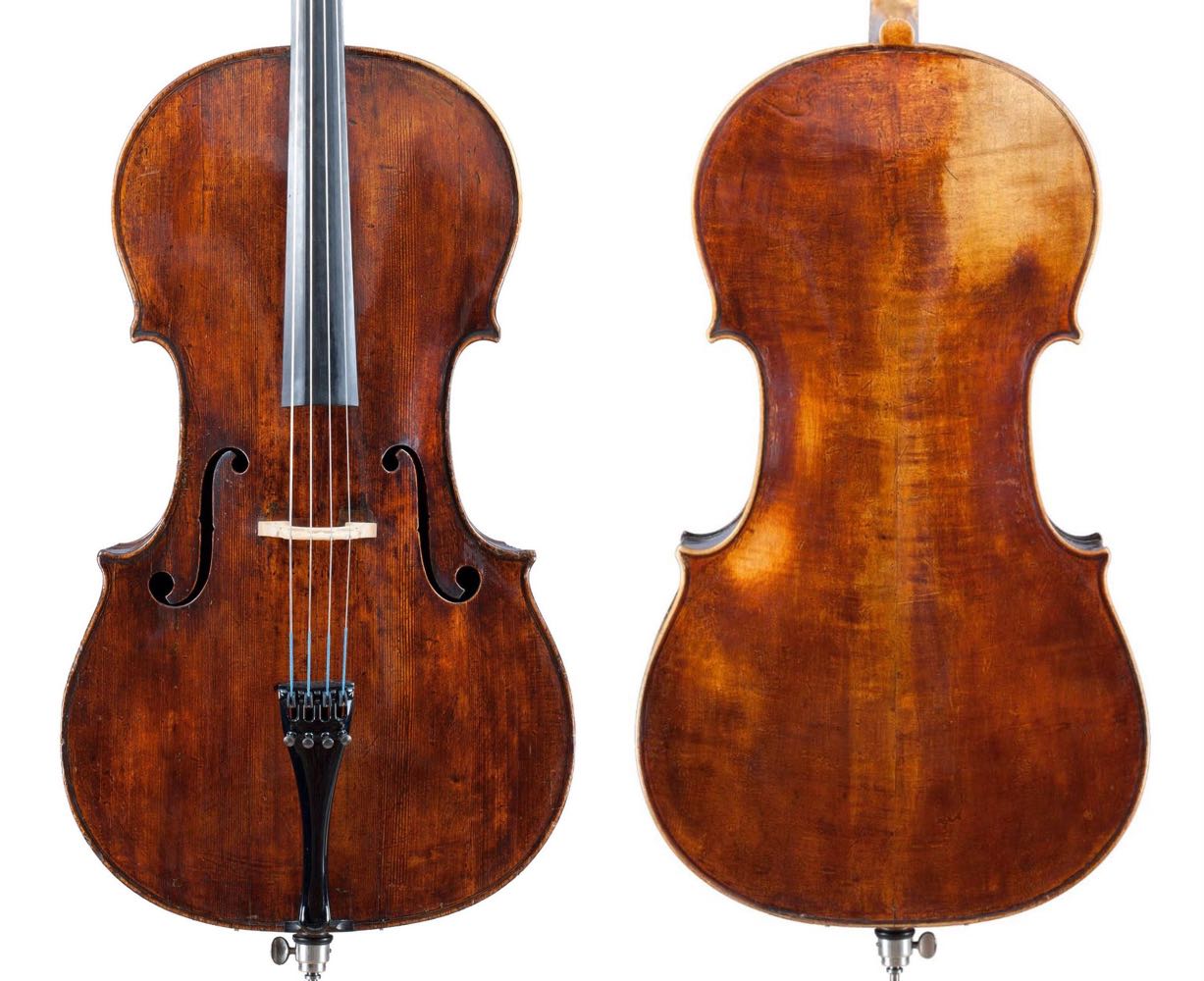
Photos: Stefan Bauni.
As a result, musicians began to seek out smaller, more manageable instruments. Makers like Guadagnini, Storioni, Serafin and Landolfi responded by producing superbly maneuverable and highly capable cellos in the 71-73 cm range. This left the question of what to do with the many magnificent violones created during the 16th, 17th and early 18th centuries.
It may sound harsh when viewed through the lens of modern conservation standards, but nearly all 17th century cellos have been reduced in size to make them more suitable for modern repertoire. Of the long-model Goffriller cellos that survive today, approximately 95% have been reduced from their original dimensions.
The ‘Casals’ was probably reduced to its current dimensions in the early 19th century. The transformation was executed carefully and tastefully but, as a consequence, the cello’s outline was altered. The skilled craftsman who performed the operation trimmed the outline in both length and width but, fortunately, left the soundholes and the space between them unchanged. The soundholes give an instrument its “face” and, many will argue, they are its primary resonance engine for tone creation.
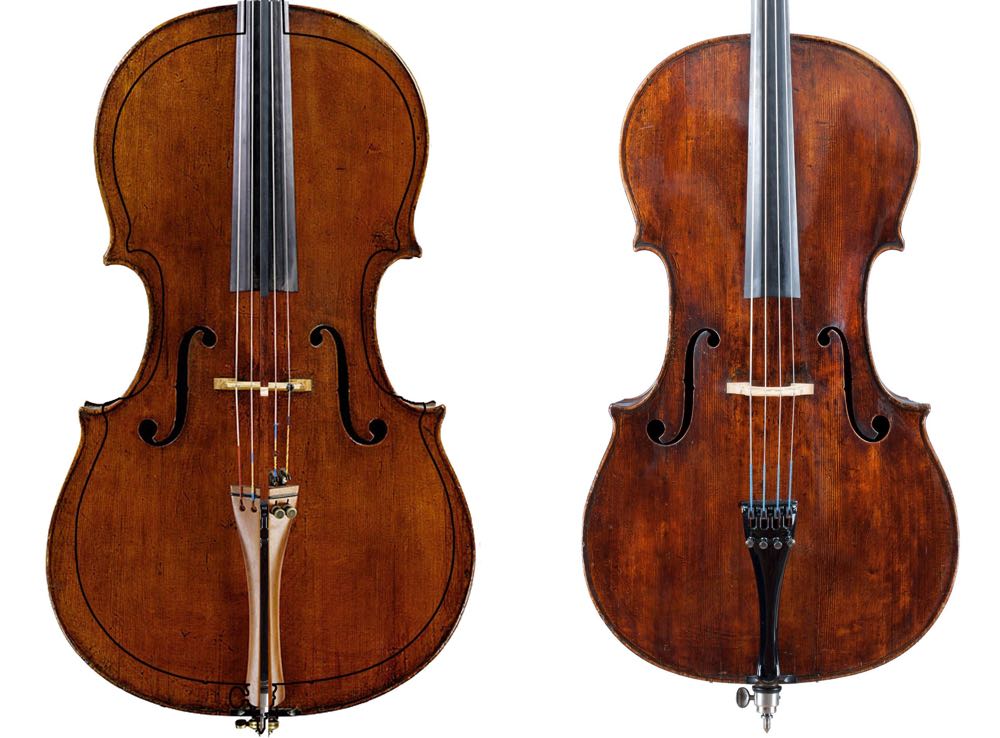
The ‘Casals’ was reduced to its present dimensions in the early 19th century. The craftsman responsible shortened the outline in both length and width, while leaving the soundholes unchanged. In this comparative image, the ‘Casals’ is overlaid on an uncut Goffriller, clearly showing the margin that was removed.
Knowing in what specific year a Goffriller was made is challenging because so few retain an original label (the 1733 on the facsimile Bergonzi label is irrelevant to the actual date this cello was made). Iconographically, this cello sits within the mature work of Goffriller, somewhere between 1700 and 1720, which is the basis for the attribution to c. 1710. A dendrochronology analysis performed by Peter Ratcliff found strong correlations for the latest rings of the treble and bass sides as 1686 and 1691 respectively, aligning well with a manufacture date of c. 1710.
Casals was the first famous cellist to choose Goffriller as his primary instrument but over the past century, many great artists have played Goffrillers, including (omitting living players): János Starker, Jacqueline du Pré, Emanuel Feuermann, Felix Salmond, Leonard Rose and Alfredo Piatti. Starker summed up his feelings for Goffriller: “I belong to the group of performers who believe that Strads require adjustment to the basic qualities of the instrument, while Goffrillers allow the player’s individuality to emerge.”
“I belong to the group of performers who believe that Strads require adjustment to the basic qualities of the instrument, while Goffrillers allow the player’s individuality to emerge.” – János Starker
Labeled Bergonzi … but made by Goffriller
Today the ‘Casals’ is universally recognized as the work of Matteo Goffriller, but in the 19th century it was believed to have been made by the Cremonese violin maker Carlo Bergonzi. This confusion between Goffriller and Bergonzi forms part of a broader and rather telling history: the misleading label in the ‘Casals’ cello was far from an isolated incident.
Most stringed instruments contain a small paper label inside the body, visible through the soundholes, identifying the maker, place and date of manufacture. Yet, for a variety of reasons—some innocent, others less so—many labels found in antique instruments are not original. In some cases, they are facsimiles intended to replace a lost original; in others, they indicate an entirely different name, often upgrading the instrument to a more prestigious attribution.
The label currently found in the ‘Casals’ cello reads “Anno 1733 Carlo Bergonzi fece in Cremona” (Made by Carlo Bergonzi in Cremona in 1733). We don’t know who inserted the label or when, but we know it has been there since at least the mid 19th century.
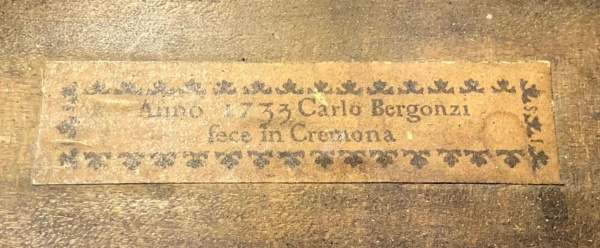
This facsimile Bergonzi label has been present in the instrument since at least the mid-19th century and remains there today.
Although Bergonzi and Goffriller were contemporaries, it is unlikely they had any direct connection. Bergonzi (1683–1747) was one of the last master makers in the great Cremonese tradition, while Goffriller stands at the forefront of the Venetian school. Bergonzi worked primarily as a violin maker; only two cellos can be reliably attributed to him and neither bears an original label. Goffriller, by contrast, seems to have concentrated on cellos, which today form the core of his reputation.
Complicating matters further, many of Goffriller’s instruments were originally made without labels, likely in response to Venice’s complex guild and taxation systems and Goffriller’s efforts to evade them. As a result, a significant number of Goffriller instruments left his workshop unlabeled.
Cremona was where the money was, and since Bergonzi cellos were rare and no one really knew what they looked like, they made an easy target.
Confronted with anonymous cellos that were beautiful, expertly crafted and tonally outstanding, dealers and experts—sometimes optimistically, sometimes opportunistically—began assigning more commercially desirable names. Cremona was where the money was, and since Bergonzi cellos were rare and no one really knew what they looked like, they made an easy target.

From a letter from Pablo Casals to Marcel Vatelot on 26 March 1921: “Je possède également un Bergonzi Goffriller avec lequel j’ai joué longtemps.” (I also own a Bergonzi Goffriller, which I have played for a long time.) Fundació Pau Casals Archive
Over time, the misattribution snowballed; false attributions served as reference examples and dozens of so-called “Bergonzi” cellos entered circulation, which were in fact the work of Goffriller. Casals’s instrument was one such case, its mistaken identity reflecting a broader 19th-century culture of enthusiasm, speculation, and evolving connoisseurship.
Ironically, the false Bergonzi label in the instrument today and the legacy of the misattribution now make up an authentic part of the cello’s history. When Casals bought this cello in 1908, he knew he was buying a Goffriller. Nevertheless he referred to it affectionately as his “Bergonzi Goffriller.”
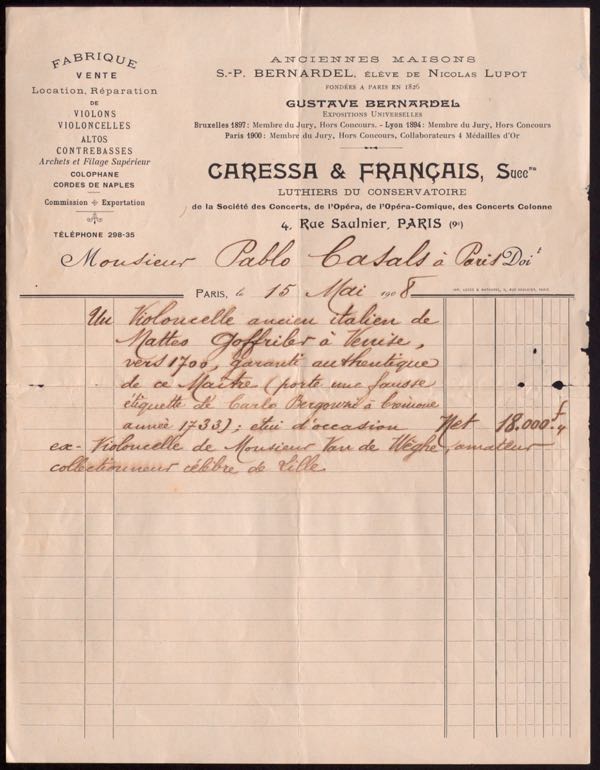
The original receipt when Casals purchased the Goffriller in Paris in 1908 recorded the sale of a Matteo Goffriller cello made in Venice in circa 1700 bearing a false label of Carlo Bergonzi, 1733. Fundació Pau Casals Archive.
Provenance
Like many great Italian instruments, this cello had made its way to England by the mid 19th century. In England the culture of the affluent amateur was a strong driver in the market and siphoned many great 17th and 18th century Italian instruments out of Italy. The English economy was strong and the English commitment to collectionism was at its height in Victorian times.
The first recorded owner of the cello was John van Somer of Stamford Hill in north-west London. Upon his death around 1875 the cello went to the London dealers W. E. Hill & Sons who sold it to the Glasgow collector and dealer, David Laurie. The cello features in Laurie’s whimsical memoir, Reminiscences of a Fiddle Dealer, when he sold it in 1879 for £240. Interestingly, the Hills’ account of the transaction makes it clear that they knew it was a Goffriller, not a Bergonzi (Arthur Hill writes in his diary, “it used to be called a Carlo Bergonzi until we assigned to it its right name”) but Laurie likely recognized the commercial benefit of selling it as a Bergonzi.
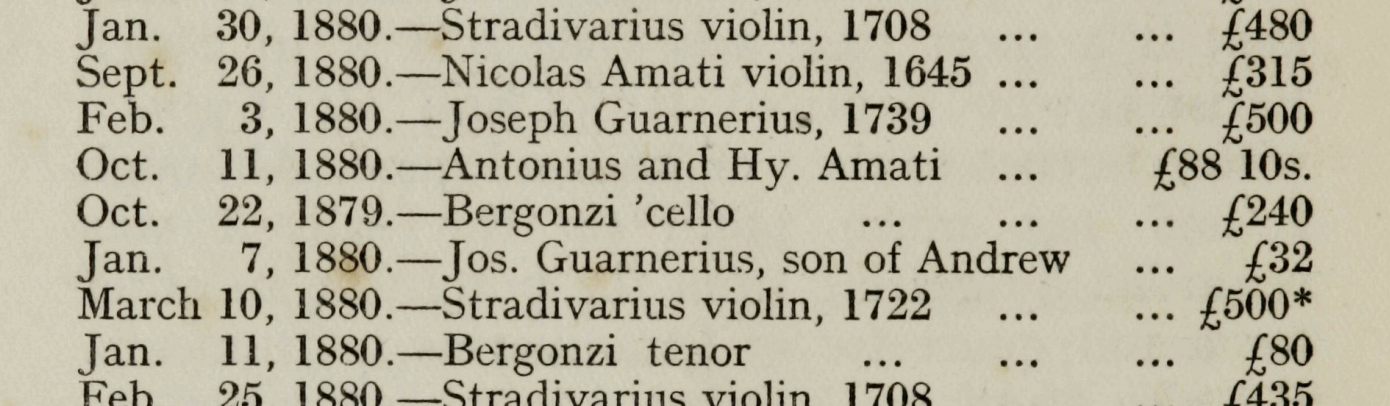
From Reminiscences of a Fiddle Dealer: Laurie bought the cello from Hills as a Goffriller but sold it as a Bergonzi, knowing that would bring the higher price.
Nearly twenty years later the cello resurfaced again, this time in the possession of Edouard van de Weghe (1829—1896) an instrument collector, amateur musician and patron of the Lille Conservatoire. After Mr. van de Weghe’s death in 1896 his son wrote to W. E. Hill & Sons mentioning his father’s violins by Stradivari, Guarneri, Amati and cellos by Bergonzi [sic] and Vuillaume. The collection was ultimately sold at auction at Hôtel Drouot in Paris in May 1897. It’s unclear who bought the Goffriller cello at the auction but ten years later it was for sale again at the Paris dealers Caressa & Français.
Pablo Casals was a regular client of Caressa & Français as early as 1900. Their repair records document work on the Gagliano cello presented to him by the Queen of Spain, the instrument he played prior to acquiring the Goffriller. On 14 May 1908, Casals purchased the Goffriller, which would remain his musical voice for the next sixty-five years.
While some musicians do remain with a single instrument throughout their careers, it is far from the norm. What is striking in Casals’s case is that he could have chosen from among the most celebrated Stradivari cellos in existence, yet deliberately remained with his Goffriller. This decision reflects not only a rejection of the prevailing hierarchy that placed Cremonese instruments above all others, but a deeper artistic conviction: the pursuit of an individual voice over inherited prestige.
In 1995, his wife, Marta Casals recalled, “In his last years Maestro Casals referred to his cello as his ‘oldest friend’.”
Provenance
until 1875 John van Somer
in c. 1875 W. E. Hill & Sons
in 1879 David Laurie
1879 – c.1896 Edouard van de Weghe
in 1908 Caressa & Français
1908 – 1973 Pablo Casals
from 1973 Fundació Pau Casals (under the usufruct of his widow Marta Casals)
Up close with the ‘Casals’ Goffriller
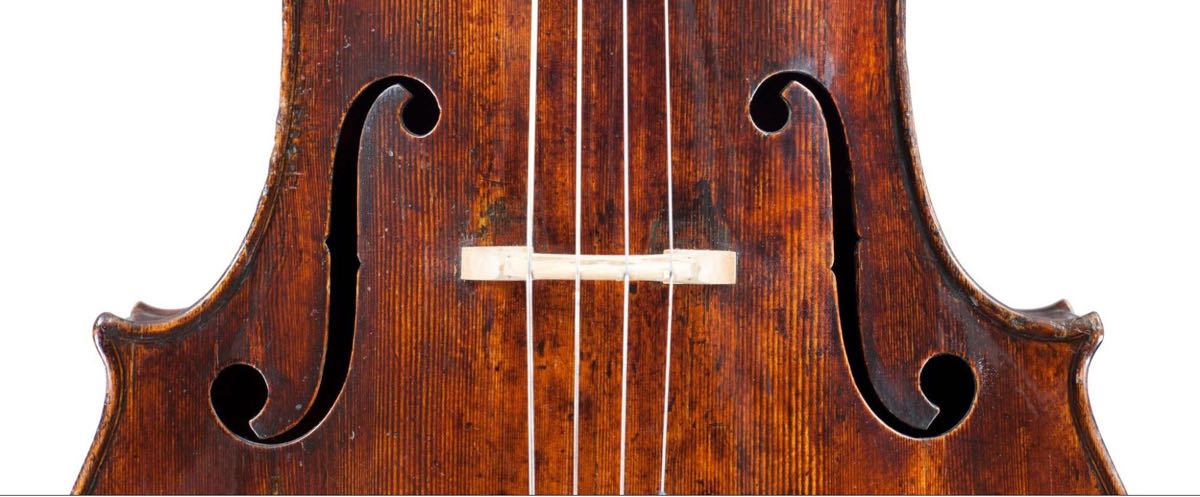
Photo: Stefan Bauni.
Varnish
What do we actually see when we look at the varnish on an 18th century instrument? Light is fascinating: not only does it carry information about colour—it reveals shape, texture, dimension and movement. When sunlight falls on the layers of varnish covering the Casals cello, it creates a sense of depth far greater than the few tenths of a millimetre that actually covers the wood. The light we see appears to radiate from within—which is why classical Italian varnishes are often described as ‘fiery’, ‘glowing’ or ‘luminous’.
Choose a spot on the cello and observe it from different angles. Watch how the colours shift from deep maroon-red to bright terracotta-orange as your vantage point changes. Look for the areas where the original varnish texture has survived intact, visible as a network of fine lines known as craquelure. Over time, mechanical stress, humidity and the slow processes of drying and aging have caused the original varnish layer to develop these characteristic fissures and cracks — each one a small record of the instrument’s long life.
Materials
Venice in the early 1700s was a city of wood: some 2,500 carpenters were active there, and the supply of timber must have been extraordinary. For a violin maker, finding wood of the right quality and price was probably not difficult.
The maple used for the back, sides and scroll is of the finest tonal quality with soft flame ascending on the back. The top is cut from a strongly figured spruce of very fine quality. The maple most likely arrived through one of the many trading posts strung along the Adriatic coast. The spruce was probably floated down the Adige river from the Tyrol region.
There are several large knots in the top and back plates — notice the large one that the maker filled himself. Particularly striking is the fact that the top is made from four separate spruce panels. Could the old folk tale among violin makers be true? Is it possible that Goffriller sourced some of his wood from the same supply used for gondoliers’ oars?
Venice in the early 1700s was a city of wood: some 2,500 carpenters were active there, and the supply of timber must have been extraordinary.
Model
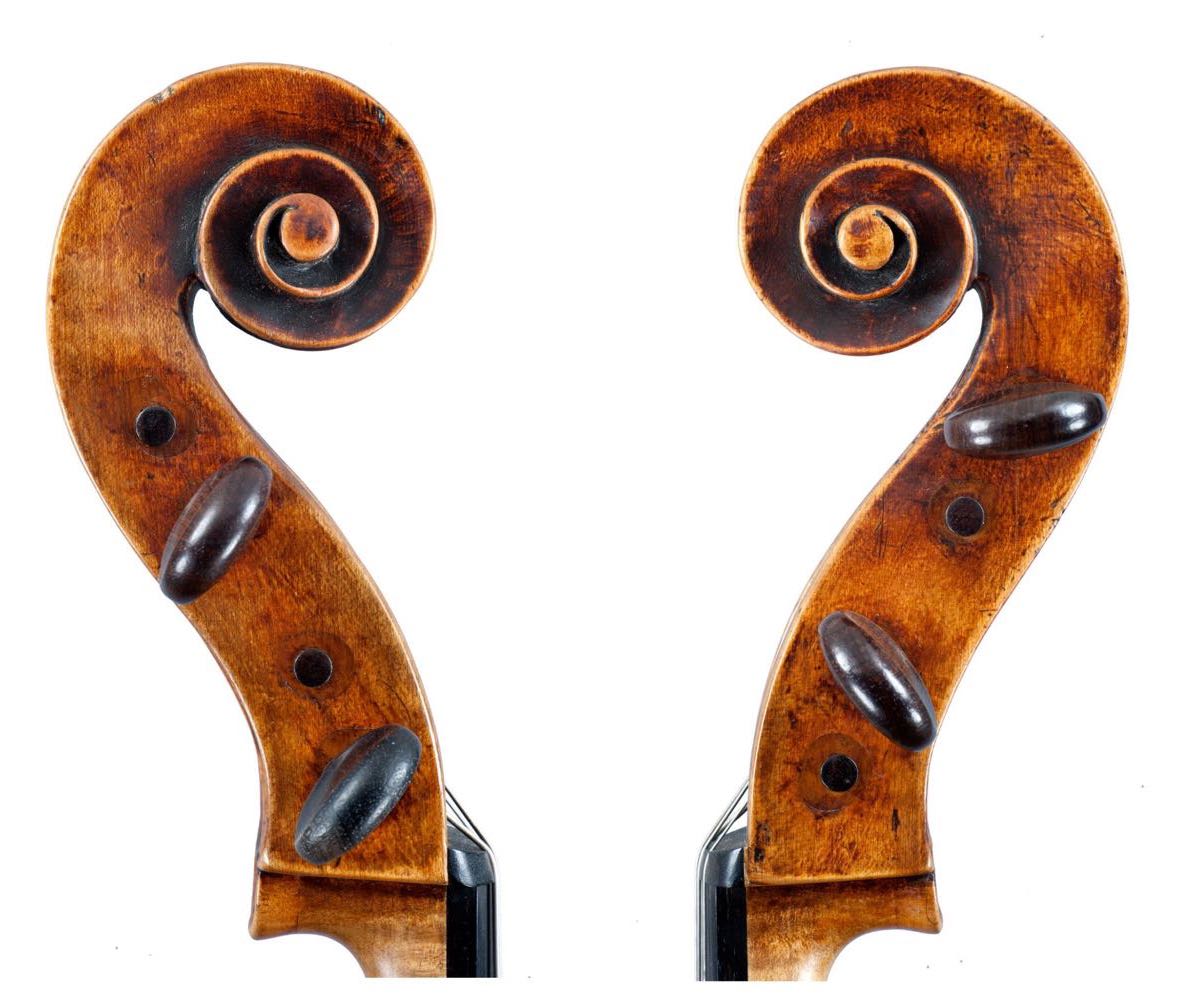
Although the cello has been reduced from its original dimensions, its authorship remains clear. The f-holes, distinctly Amati in pattern, point both to Goffriller’s hand and to the model on which the instrument was originally conceived.
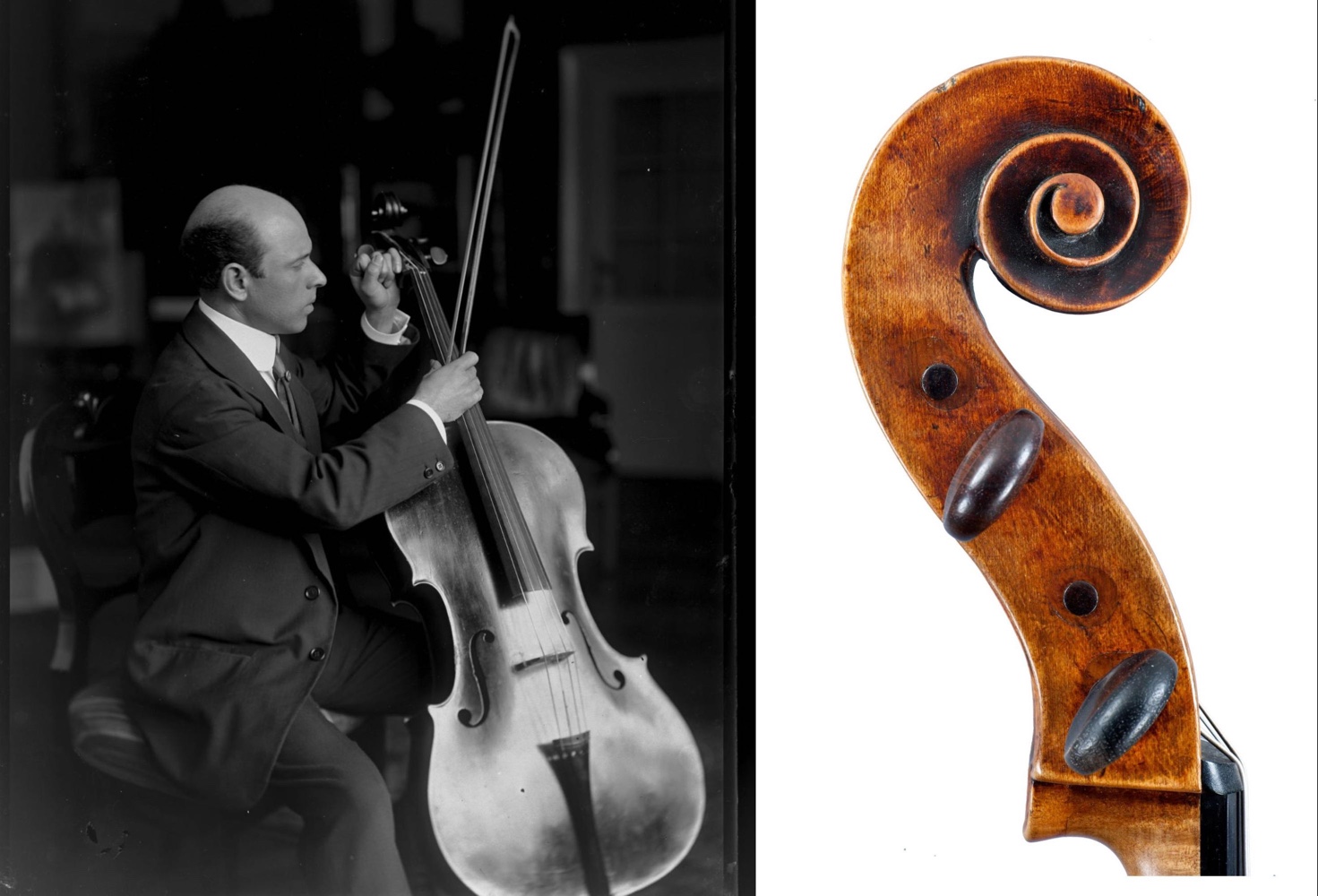
As you can see in the images, the rounded wings, full curves, and pronounced notches are distinctly Amati in character. The scroll is classic Goffriller: low-bellied, with a forward-thrusting spiral. Also typical is the very wide mortise of the pegbox — a practical choice that made the passage from string to string noticeably easier.
Photos: Stefan Bauni.
Details
There is something revealing about comparing instruments from Venice with those made in Cremona. In Cremona, violin making was a family trade, passed from father to son across generations. Working methods and construction principles were inherited almost automatically, along with the workshop itself.
In Venice, things worked differently. Makers typically came from outside the city and often married into the trade — inheriting the workshop of their predecessor rather than being born into one. Each Venetian maker brought his own character to the work, less bound by tradition, freer to follow his instincts.
That decisive, personal quality is visible in the tool marks Goffriller left on this instrument. Look for the traces left by the scraper along the body, and the marks it left running the length of the tail at the back of the scroll. Gouge marks are visible around the eye of the scroll. Not visible from the outside — but worth knowing — are the large, roughly carved willow corner blocks inside, worked with the same swift confidence that marks everything else about this extraordinary cello.
Fundació Pau Casals
Photos: Left: ÖNB/Wien, 10E59E67, Right: Stefan Bauni.
The Fundació Pau Casals is dedicated to preserving and promoting the artistic and humanistic legacy of the Catalan musician Pablo Casals. At its core is the idea of a “living heritage”: not only safeguarding Casals’s instruments, archives, and memory, but actively transmitting his values—musical excellence, integrity, and a belief in music as a force for humanity—to future generations. Through educational initiatives, performances, and cultural programming, the foundation continues Casals’s lifelong commitment to nurturing young musicians and advancing music as a moral and social force.
With the intention of preserving and ensuring the continuity of the mythic instrument, Pau Casals bequeathed his Goffriller cello to the Fundació Pau Casals, stipulating that his widow, Marta Casals, would hold its usufruct. She has been responsible for and taking care of it until recently and has now handed it over to the Foundation.
In 2026, this mission takes on a powerful and highly symbolic form. The foundation will loan the celebrated Matteo Goffriller cello known as the “Casals” to the First Prize winner of the Queen Elisabeth Competition. Casals performed on this instrument for more than sixty years, regarding it as the ideal vehicle of his musical expression.
The gesture also reflects a historical relationship of unusual depth. Pablo Casals and Queen Elisabeth of Belgium shared a friendship marked by mutual respect that extended far beyond the musical sphere, grounded in shared ideals and personal admiration. The loan, granted for four years, not only honors that connection but embodies the foundation’s broader purpose: keeping Casals as a crucial source of musical and human inspiration for future generations.
 |
 |
 |
 |